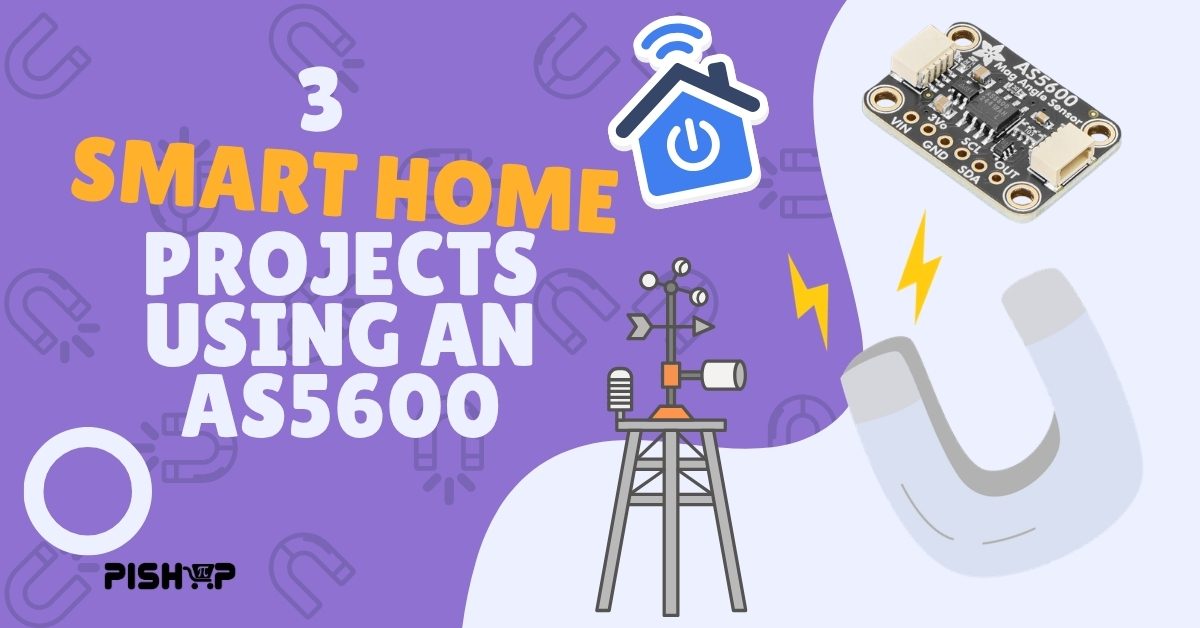
Frictionless Sensing: 3 Smart Home Projects Using Magnetic Angle & Distance Sensors
3D Printing, Arduino, Beginner, ESP, Home Automation, Intermediate, PiShop, Platforms, Projects, Raspberry Pi, Raspberry Pi Pico, Skills arduino, as5600, ESP32, raspberry pi, smart home, Tech 0
If you’ve ever fought with a scratchy potentiometer or a mechanical rotary encoder that eventually wears out, you’ll appreciate what the AS5600 brings to the table. It’s a small, unassuming chip that solves a very old problem, measuring rotation, in a way that never physically touches the thing it’s measuring. That makes it a natural fit for smart home builds, where reliability and years of maintenance-free operation actually matter.
What Makes the AS5600 so Special?
The AS5600 is a 12-bit magnetic rotary position sensor. Instead of a wiper dragging across a resistive track (like a traditional potentiometer) or an optical disc with slots (like a mechanical encoder), it reads the orientation of a small diametrically magnetized magnet spinning above the chip. It can sense a rotating magnetic field from up to 3mm away, with no physical connection required.
A few numbers that matter could matter to you:
- 4096 distinct position points across a full 360° rotation, with an angle error of around ±0.3°
- Detection speeds up to 1000 RPM with a 10kHz sampling frequency
- By default it outputs a full 0–360° range, but it can be programmed with a custom zero angle and maximum angle, handy if you only need, say, 90° of travel
- It communicates over a standard I²C interface, and non-volatile settings can be programmed without a dedicated programmer
- A DIR pin lets you flip whether the output increases clockwise or counterclockwise
- Because the magnet never touches the sensor, it’s rated for well over 10 million operating cycles, effectively unlimited for a hobby project
Because there’s no mechanical wear, no dust getting into contacts, and no dead zones, “frictionless” isn’t just marketing language, it describes the physics. Here are three smart home projects that put it to creative use.
Project 1: A Nest-style Smart Control Dial
Premium smart thermostats and lighting hubs are known for one satisfying detail: a metal dial that spins smoothly and endlessly, with no clicks or hard stops. That feel comes from exactly this kind of contactless sensing.
Mount an AS5600 on a small PCB, glue a 6mm diametric magnet to the underside of a machined or 3D-printed knob, and wire it to an ESP32 over I²C. Because the sensor supports continuous 360° rotation, you can build a control that spins forever in either direction while your firmware tracks accumulated turns — perfect for scrolling through target temperatures, dimming lights, or cycling through scenes. Pair it with a push-button function (press the whole dial down) and an addressable LED ring, and you’ve got a genuinely premium-feeling smart home controller for a fraction of the retail price, that reports straight into Home Assistant or your MQTT broker of choice.
Project 2: Closed-loop motorized blinds and curtains
Most DIY motorized blinds run open-loop, the motor just runs for a fixed time or step count and hopes it lands in the right place. Over weeks of use, that drifts, and the blinds stop lining up with “fully open” or “fully closed.”
Fix it by mounting an AS5600 on the roller tube’s drive shaft, with a magnet fixed to the rotating spindle. As a DC gear motor or stepper turns the blinds, the sensor reports absolute shaft angle back to your controller in real time, so the system always knows the actual position of the blinds, not just where it thinks they should be. This makes it trivial to set precise open/close limits, support “open to 40%” voice commands, and recover cleanly after a power cut, since the AS5600 reports true position on boot with no homing routine required. The same setup works for garage doors, awnings, or a motorized pet-flap.
Project 3: A smart weather vane for real-time wind direction
Traditional weather vanes only give you a visual reading, you have to walk outside and look at it. Swap the vane’s pivot bearing for an AS5600, and it becomes a live wind direction sensor for your smart home weather station.
Mount the sensor at the base of the vane’s rotating shaft, with a diametric magnet fixed to the shaft itself, sealed inside a small waterproof housing beneath the weathervane’s body. As the vane swings freely with the wind, the AS5600 reads the shaft’s absolute angle continuously, no gearing, contacts, or brushes to corrode or seize up outdoors, which matters a lot for something permanently exposed to rain, dust, and temperature swings. An ESP32 with a weatherproof enclosure and solar/battery power reads the angle over I²C, converts it to a compass heading (N, NE, E, and so on, or a raw degree value), and reports it wirelessly to Home Assistant or an MQTT broker alongside your existing rain and temperature sensors.
Conclusion
All three projects share the same core recipe: an AS5600 breakout board, a small diametric magnet, a microcontroller with I²C support, and a 3D-printed or laser-cut mechanical housing to hold everything in alignment. From there, it’s really a question of what you want to spin, tilt, or measure.
If you’re building any of these, pay attention to sensor-to-magnet spacing and centering, the AS5600 is forgiving, but keeping the magnet on-axis and within its rated distance gives you the cleanest readings.
Have you built any of your own projects with an as5600 sensors or just your own smart home projects in general? Make sure to share it with us in the comments or if you can think of some better uses for this sensor!